| Summary: Choose a rectangular pool for efficient swimming, a freeform pool for an organic outline, or a plunge pool for a compact backyard. Compare usable water area, construction material, automatic-cover compatibility, circulation, and total installation costs before choosing a shape. |
A pool outline affects more than appearance. It determines how much of the excavated footprint becomes usable water, where steps and benches fit, how the deck meets the coping, and which safety-cover systems are practical. It also influences how a builder lays out the shell and how the circulation system reaches corners and curved sections.
The shape names below are not all the same kind of category. Rectangle, oval, kidney, and Roman describe outlines; lap and plunge describe intended use; infinity edge describes a feature that can be added to several outlines.
Quick Answer: Which Swimming Pool Shape Should You Choose?
Choose a rectangular pool if you prioritize lap swimming and automatic-cover compatibility. Select a freeform or kidney pool for natural, resort-style landscaping. For tight spaces, a plunge pool offers the most compact relaxation footprint. Always verify your yard dimensions and build materials before choosing.
14 Swimming Pool Shapes and Types
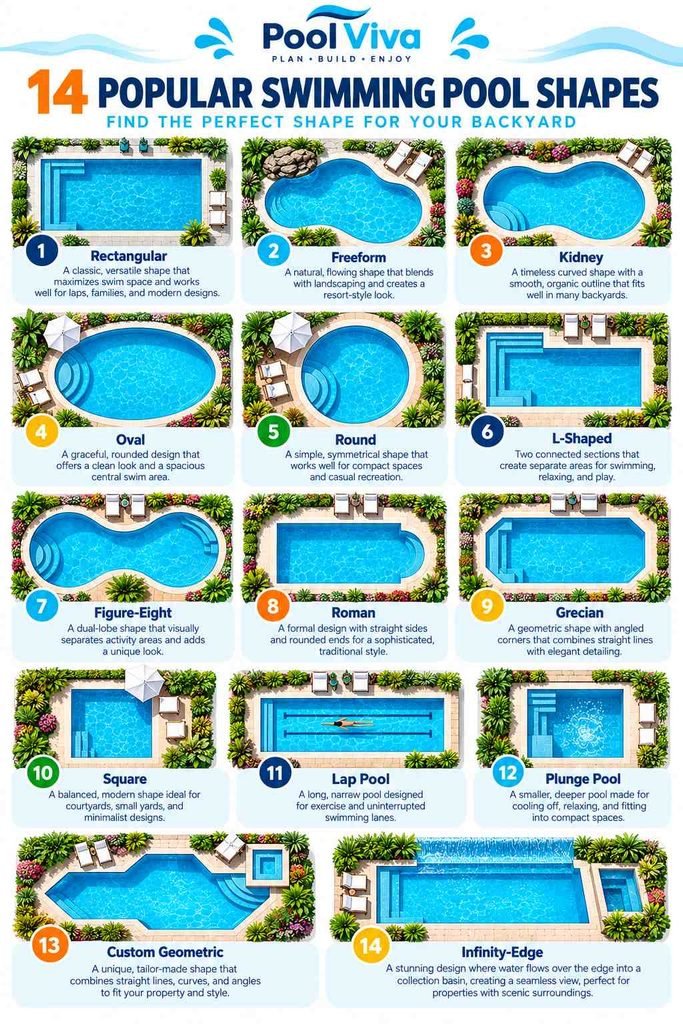
1. Rectangular Swimming Pools
Straight sides make a rectangle efficient for lap swimming, automatic-cover planning, and square-edged decking. A 10 × 30 ft rectangular pool has 300 square feet of surface area before accounting for steps or a tanning ledge. This gives you a baseline when comparing curved pools with the same outside dimensions.
- Trade-off: The formal outline may feel rigid in a landscape built around sweeping garden beds or irregular paths.
- Best fit: Exercise, family use, and backyards where space needs to be used efficiently.
2. Freeform Swimming Pools
Freeform pools use a flowing perimeter rather than a fixed geometric outline. The curves can follow an irregular property line or wrap around a lounging area. However, every inward curve reduces the water area inside the pool’s overall length and width.
- Trade-off: Custom coping, deck transitions, cover fabrication, and cleaning paths need closer coordination.
- Best fit: Homeowners who value an organic outline more than a long, uninterrupted swim lane.
3. Kidney-Shaped Swimming Pools
A kidney pool has two rounded lobes joined by an inward curve. The indentation creates a visual break in the outline, but it does not create two functional zones. Depth, steps, and circulation determine how the pool actually works.
- Trade-off: The inside curve can interrupt a straight swim route and deserves attention when positioning return jets and steps.
- Best fit: Traditional backyards where a curved pool is preferred over a full freeform layout.
4. Oval Swimming Pools
An oval has rounded ends and a continuous perimeter, with a broad central area and no sharp corners. Compared with a rectangle of the same overall length and width, the curved ends reduce the water surface inside those dimensions.
- Trade-off: Rounded ends reduce straight-line swimming distance and may complicate automatic-cover choices.
- Best fit: Casual recreation when a softer, symmetrical outline is preferred.
5. Round Swimming Pools
Round pools are common in above-ground installations and compact soaking or recreation areas. Their circular outline works well where symmetry matters, but a circle uses more width than a long, narrow rectangle with a similar surface area.
- Trade-off: There is no long, straight lane for conventional lap swimming.
- Best fit: Casual use, above-ground pools, and compact spaces with enough width.
6. L-Shaped Swimming Pools
An L-shaped pool joins two rectangular sections at a right angle. The longer leg can be reserved for swimming while the shorter leg accommodates steps, shallow-water play, or a separate seating area. These functions need to be built into the depth profile rather than assumed from the outline.
- Trade-off: The inside corner adds layout work for the shell, coping, cleaning, and circulation.
- Best fit: Properties where two distinct uses need to fit within one pool.
7. Figure-Eight Swimming Pools
A figure-eight outline has two rounded lobes connected by a narrower middle. The shape can separate activity areas visually, but the middle connection may restrict movement if it is too narrow or if steps and benches occupy the same zone.
- Trade-off: The waist and curved perimeter need deliberate return-jet placement and cover planning.
- Best fit: Owners who want a traditional two-lobed pool and do not need a full-width swimming lane.
8. Roman-Shaped Swimming Pools
Roman pools usually combine straight sides with semicircular or rounded ends. The center retains much of a rectangular pool’s character, while the ends create a more decorative profile.
- Trade-off: The end geometry reduces usable straight length and affects cover and coping details.
- Best fit: Traditional or formal settings that suit a structured outline with curved ends.
9. Grecian-Shaped Swimming Pools
Grecian pools are generally rectangular with clipped or angled corners. The result keeps long straight sides while adding geometric detail at the corners. Those clipped sections still need accurate dimensions when a cover or prefabricated component is specified.
- Trade-off: Angled corners need to be included in cover measurements and deck detailing.
- Best fit: Homeowners who want a geometric pool with more detail than a plain rectangle.
10. Square Swimming Pools
Square pools suit courtyards and compact outdoor rooms where a balanced outline matters more than a long swim lane. They are often used for cooling off, lounging, or as the water area within a larger patio.
- Trade-off: The width can consume a large share of a small yard, and the pool is less suited to continuous lap swimming.
- Best fit: Courtyards, compact recreation pools, and plunge-pool layouts.
11. Lap Pools
A lap pool is a use-driven format, usually long and narrow, rather than one unique geometric shape. A straight rectangle is the common choice because it maximizes uninterrupted swim lanes and simplifies turns.
- Trade-off: Narrow width leaves less room for group play, floating, or side-by-side use.
- Best fit: Regular exercise on a property with enough length.
12. Plunge Pools
A plunge pool prioritizes cooling off and relaxing over swimming lengths. It may be rectangular, square, round, or custom-shaped, with built-in seating or jets taking up some of the water area.
- Trade-off: Small volume does not mean low cost per square foot. Heating, jets, finishes, access, and equipment still contribute to the bill.
- Best fit: Small backyards and owners who want a compact place to soak or cool off.
13. Geometric and Custom-Shaped Pools
A custom geometric pool may combine straight runs, angled corners, ledges, and tight radii to fit a particular property. In a shotcrete or gunite build, the shell can be formed to a bespoke layout, but that flexibility brings more design coordination and field labor.
Tight internal radii require careful excavation, steel-reinforcement placement, forming, and finish work. For a builder’s overview of the differences, see this guide to geometric and freeform pool shapes.
- Trade-off: More corners and unique details mean more opportunities for labor, material waste, and rework if the drawings are incomplete.
- Best fit: Sites where a standard shell cannot meet the space or functional requirements.
14. Infinity-Edge Pools
An infinity edge is a hydraulic feature, not a separate geometric shape. Water flows over a precisely set weir into a catch basin or balance tank and is pumped back into the pool. The main pool may still be rectangular, freeform, or another shape.
- Trade-off: The edge adds structural and hydraulic design, waterproofing, extra plumbing and pumps, and a collection basin. On US projects, the upgrade often adds tens of thousands of dollars; request a line-item quote for the specific site.
- Best fit: Properties with a meaningful view or elevation change that justifies the additional system.
Compare the Main Options
| Shape or type | Swimming space | Cover and construction considerations | Typical use |
| Rectangle | High usable area within its footprint | Usually simplest for standard automatic-cover geometry | Exercise and general use |
| Freeform | Curves reduce usable area inside the same bounding box | Custom cover and coping details may increase costs | Organic or resort-style settings |
| Kidney or figure-eight | Inside curves and narrow connections interrupt straight paths | Plan returns, steps, and cleaner access around curves | Traditional curved layouts |
| Oval or Roman | Broad central area, less straight length at the ends | Curved ends affect cover fit and measurements | Casual recreation |
| Grecian | Mostly straight swimming area | Clipped corners need accurate cover measurements | Geometric look with detail |
| Lap | High uninterrupted lane length | Check length, width, turn space, and safety access | Fitness |
| Plunge or square | Compact water area | Heating, jets, seating, and access may dominate costs | Cooling off and lounging |
| Custom shotcrete | Depends on final shell geometry | More layout, reinforcement, forming, and finish coordination | Site-specific layouts |
| Infinity edge | Depends on the underlying pool shape | Catch basin, pumps, waterproofing, and precision weir | View-focused properties |
Construction Material Limits Shape Choices
The pool shell material narrows the options before excavation begins.
Fiberglass pools arrive as factory-molded shells. Buyers choose from the manufacturer’s available shapes and sizes; a builder cannot reshape the shell on site to match a one-off outline. Compare actual shell dimensions, steps, benches, and waterline—not just the catalogue image. See the manufacturer’s overview of fiberglass pool shapes.
Vinyl-liner pools accommodate many outlines, but every inside corner, radius, step, and floor transition must be compatible with the liner pattern and support structure. Complex geometry is not impossible. It calls for a builder and liner supplier experienced with that configuration. Ask how the liner is templated, where seams fall, and how tight corners are supported before approving the plan.
Shotcrete or gunite pools offer the broadest freedom for a custom outline because the reinforced shell is formed on site. Structural engineering, soil and groundwater conditions, reinforcement detailing, waterproofing, and the finish system all need to be designed for the project. A complex curve or infinity edge should be priced from coordinated drawings, not a rough sketch.
The Hidden Costs Behind a Pool Shape
Automatic pool covers
A straight rectangular pool is generally the easiest starting point for an automatic cover because tracks and cover geometry are straightforward. Freeform outlines, angled corners, tanning ledges, and infinity edges may require custom fabrication, track changes, or a different cover arrangement.
Some installations use deck-mounted tracks; recessed or under-track systems need more coordination and labor. Confirm the cover design before the pool shell and deck are finalized. Read how pool shape and track selection affect automatic-cover pricing.
Do not assume every freeform pool needs an underground rectangular vault, or that every rectangle accepts the same cover. The cover maker’s system, the pool dimensions, and the deck construction determine what is feasible. Request the exact system, track detail, and installation cost in writing.
Excavation, steel, and finishing labor
Straight lines and repeated dimensions are generally easier to lay out than a custom outline with multiple tight internal radii. Complex shotcrete pools require more detailed excavation, careful rebar placement around curves, and more precise forming and finishing.
Site access, rock, groundwater, retaining requirements, and spoil removal may cost more than the outline itself. Ask contractors to itemize site work separately from the pool shell.
Budgeting an infinity edge
An infinity edge is a major system upgrade rather than a decorative coping choice. The quote should identify the catch basin or balance tank, structural wall, waterproofing, additional circulation equipment, plumbing, controls, and precision work at the weir.
Industry cost guides describe this as a substantial premium over a comparable conventional pool, often reaching tens of thousands of dollars in the US. The final amount depends heavily on grade, access, edge length, finishes, and local labor. Compare itemized bids instead of relying on a universal percentage.
Compare Usable Swim Area, Not Just Overall Dimensions
A pool’s outside length and width describe its bounding rectangle, not the amount of water surface inside it. A 10 × 30 ft rectangular pool has 300 square feet of surface area before steps or ledges. A freeform pool that fits within the same 10 × 30 ft envelope has less surface area because its curved edges cut into that rectangle.
The difference matters most when the goal is lap swimming, floating, or several people using the pool at once.
Ask the builder for:
- Actual water-surface area.
- The longest uninterrupted swim line.
- Minimum width.
- Area occupied by steps, benches, and tanning ledges.
These measurements make comparisons between shapes more useful than catalogue dimensions alone.
Circulation, Cleaning, and Curved Areas
Pool shape does not determine water chemistry by itself, but corners, recessed curves, benches, and narrow connections can make circulation and cleaning less forgiving. If return jets do not move water through these areas, fine debris may settle and algae may gain a foothold where brushing and sanitizer distribution are weaker.
Builders should plan return locations, skimmers, drains, and flow rates for the actual geometry rather than placing fittings by habit.
Ask the installer to explain how water moves through the inside curves of a kidney or figure-eight pool and how the chosen robotic cleaner handles steps, benches, and tight turns. A cleaner’s navigation pattern and manufacturer coverage claims matter more than a general label such as “works for all pool shapes.”
After installation, follow a consistent brushing and testing routine. Pool Viva’s pool cleaning and maintenance guides can support that routine.
How to Choose a Shape for Your Backyard
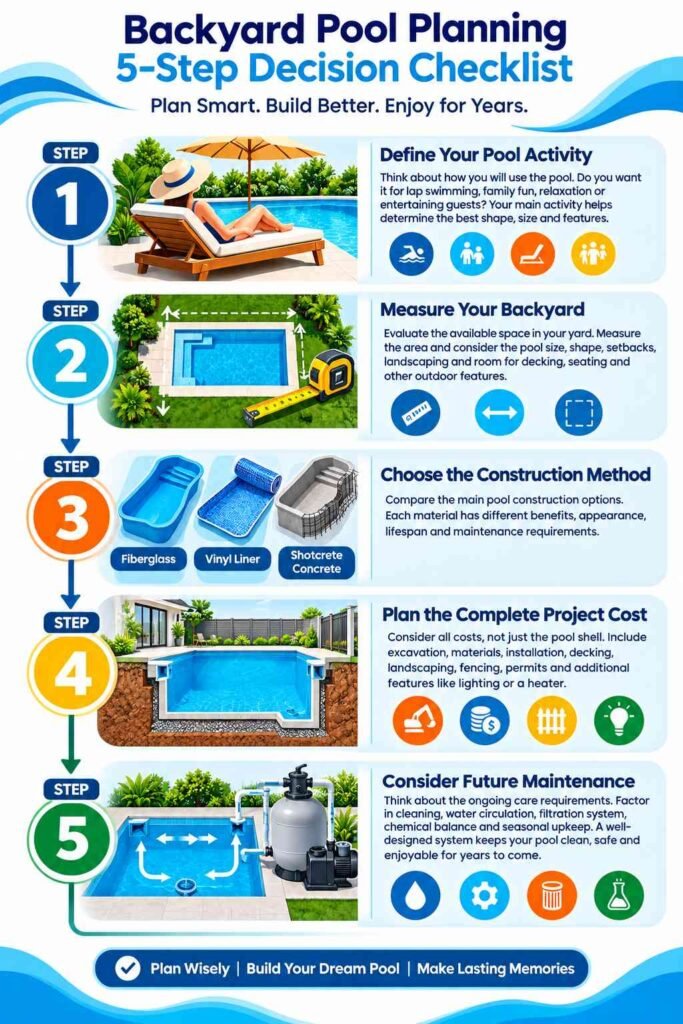
Start with the activity
Decide whether the pool is mainly for laps, family play, cooling off, or relaxing. A pool designed around exercise needs uninterrupted length; one designed for lounging may devote more space to benches or a tanning ledge.
Measure the complete layout
Mark the pool, deck, access path, equipment route, barriers, gates, and any required setbacks. Check local building and barrier rules before finalizing dimensions. The CPSC’s home pool safety barrier guidance is a useful starting point, alongside local code and your authority having jurisdiction.
Match the construction method
Ask which shapes are available for fiberglass, what liner details a vinyl design needs, or what engineering and forming are required for a custom shotcrete shell.
Price the entire installation
Compare excavation, shell, plumbing, filtration, coping, decking, cover, fencing, electrical work, drainage, landscaping, and permit costs. A lower shell quote may exclude expensive items needed to finish the pool safely.
The Pool & Hot Tub Alliance’s guide to pool ownership is another useful starting point when preparing questions for prospective builders.
Plan future care
Confirm access to equipment, cleaner compatibility, cover servicing, water testing, and the location of skimmers and returns. These decisions are less expensive to resolve on drawings than after the pool is built.
Common Mistakes to Avoid
- Choosing by photograph alone. Ask for a dimensioned plan and calculate the actual water area.
- Finalizing the shell before choosing a cover. Cover tracks, deck elevations, and the mechanism need to be coordinated early.
- Treating a custom curve as a cosmetic change. It affects layout, reinforcement, coping, finish work, and sometimes cover costs.
- Ignoring circulation around steps and inside curves. Have the builder explain return-jet placement and cleaner coverage for the chosen outline.
- Comparing quotes with different scopes. Check whether excavation, drainage, equipment, fencing, deck, permits, and startup are included.
Frequently Asked Questions
Which pool shape gives the most usable swimming space?
For the same overall length and width, a rectangle usually devotes more of the footprint to water and preserves the longest straight swim line. Steps and ledges still reduce usable area.
Are fiberglass pools available in custom shapes?
Fiberglass shells are factory-molded, so choices are limited to the manufacturer’s available molds. Custom shotcrete construction offers much more freedom for a one-off outline.
Does a freeform pool cost more to cover?
It often requires a custom cover or different track arrangement, which may increase the price. The exact cost depends on the cover system and pool details; confirm it with the manufacturer before construction.
Do curved pools have more algae problems?
Yes, poorly circulated or hard-to-brush areas can collect debris and develop algae, but good hydraulic design, correct sanitizer levels, and routine brushing reduce the risk.
What should I compare in contractor quotes?
Compare the dimensioned shell, actual water area, site work, structure, waterproofing, plumbing, filtration, cover, deck, safety barriers, permits, and exclusions. For an infinity edge, check that the basin and extra hydraulic equipment are itemized.