| Summary: Pool chemicals are used for different jobs, including sanitizing water, controlling pH and alkalinity, protecting pool surfaces, oxidizing swimmer waste, improving water clarity, and treating algae, stains, and scale. No single chemical handles every pool problem, so choosing the right product starts with understanding what the chemical is designed to do. For most residential pools, chemical decisions should be based on water-testing results, pool volume, the existing treatment system, and the product label. Choosing a chemical for the actual problem helps prevent unnecessary treatment and additional water-balance issues. |
Pool chemicals are substances added to swimming pool water to maintain sanitation, water balance, clarity, and surface protection. Some chemicals are used routinely, while others are intended for specific problems.
For example, chlorine is primarily used for sanitation, muriatic acid lowers pH, baking soda raises total alkalinity, and cyanuric acid helps protect chlorine from sunlight. Specialized products can address common pool problems such as algae, metal stains, scale, cloudy water, foam, or excess organic contaminants.
Understanding the purpose of each chemical makes pool maintenance more predictable and helps you select products according to their intended role.
Pool Chemical at a Glance
| Category | Main Purpose | Examples |
| Sanitizers & Disinfectants | Control microorganisms | Chlorine, bromine, PHMB |
| pH & Alkalinity Adjusters | Balance pH and alkalinity | Muriatic acid, baking soda, soda ash |
| Mineral Balancers & Protectors | Manage mineral levels | Cyanuric acid, calcium chloride |
| Shock Treatments & Oxidizers | Break down contaminants | Cal-hypo, MPS, hydrogen peroxide |
| Water Clarification | Improve water clarity | Alum, polyacrylamides, chitosan |
| Algae, Stain & Scale Treatments | Address specific water problems | Copper sulfate, HEDP, citric acid |
| Specialty Maintenance | Handle specific contaminants or foam | Enzymes, PDMS |
1. Pool Sanitizers & Disinfectants
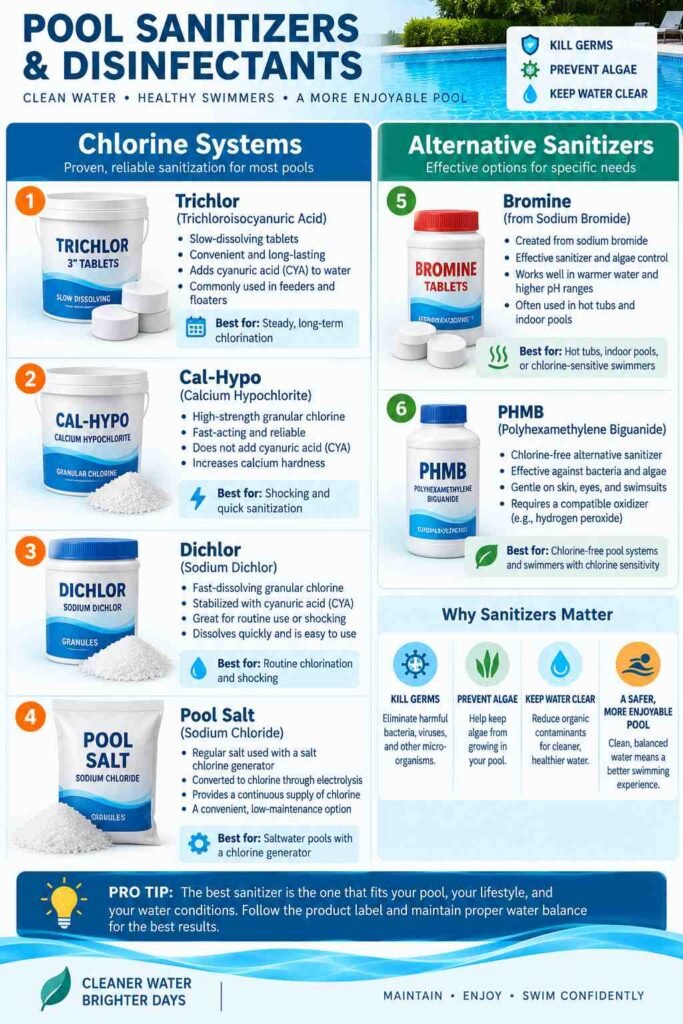
Sanitizers are responsible for controlling microorganisms in pool water. Chlorine is the most common sanitizer for residential swimming pools, although bromine and chlorine-free systems such as polyhexamethylene biguanide are also available.
For residential pools, CDC’s pool water treatment guidance explains current recommendations for chlorine, pool pH, and routine testing.
Chlorine
Chlorine is the broad chemical category used for chlorine-based pool sanitation. When chlorine is added to water, it produces active chlorine that can destroy many microorganisms.
Different chlorine products have different characteristics. Some dissolve quickly, some contain stabilizer, and others add calcium to the water. The product selected therefore affects more than just the free-chlorine level.
Free chlorine is the measurement pool owners generally use to determine how much active chlorine is available for sanitation. Its effectiveness is also affected by factors such as pH, sunlight, temperature, and the amount of contamination in the water. You can use a pool chlorine calculator to know the amount of free chlorine your needs.
Trichlor (Trichloroisocyanuric Acid)
Trichlor, or trichloroisocyanuric acid, is a stabilized chlorine product commonly sold as tablets or sticks for gradual chlorine release. It also adds cyanuric acid (CYA) to the water as it dissolves, so continued use can increase CYA levels over time. Trichlor is typically used in feeders or floating dispensers designed for the product, and it should be used according to the manufacturer’s instructions.
Calcium Hypochlorite
Calcium hypochlorite, commonly called cal-hypo, is a solid chlorine product available in granular and shock formulations. It raises free chlorine relatively quickly and is widely used for chlorination and shock treatment.
Because calcium hypochlorite also adds calcium, repeated use can increase calcium hardness. This is important for pools where calcium levels are already elevated.
Dichlor (Stabilized Chlorine)
Sodium dichloro, often called dichlor, is a fast-dissolving granular stabilized chlorine.
Unlike calcium hypochlorite, dichlor does not add calcium. However, it adds cyanuric acid to the water. Continued use can therefore cause CYA levels to rise, which makes periodic CYA testing important.
Pool Salt (Sodium Chloride)
Sodium chloride, or ordinary pool salt, is used in saltwater chlorine pools. The salt itself is not the primary sanitizer. Instead, a salt chlorine generator converts dissolved salt into chlorine through an electrochemical process.
A saltwater pool is therefore still a chlorine pool. The main difference is that chlorine is generated from salt rather than repeatedly being added as a conventional chlorine product. Use a pool salt calculator to achieve accurate salt levels for a safe swimming.
Sodium Bromide
Sodium bromide provides bromide ions that can be converted into active bromine when an appropriate oxidizer is present.
It is therefore a bromide source rather than a complete standalone sanitation system. Bromine-based treatment is more common in spas and hot tubs, although bromine systems can also be used in pools.
Polyhexamethylene Biguanide
Polyhexamethylene biguanide, commonly abbreviated PHMB, is a chlorine-free sanitizer.
PHMB systems use a different treatment approach from chlorine and bromine systems and require compatible supporting products. A pool using PHMB should be managed as a complete PHMB system rather than combining individual products from different sanitation methods.
2. pH & Alkalinity Adjusters
pH and total alkalinity are two of the most important aspects of pool water balance. pH indicates how acidic or basic the water is, while total alkalinity helps the water resist rapid changes in pH.
For practical testing guidance, Taylor Technologies’ water-testing resources explain common pool-water measurements and testing methods.
Hydrochloric Acid / Muriatic Acid
Hydrochloric acid, commonly called muriatic acid for pool use, is a strong liquid acid used to lower pH. It can also reduce total alkalinity when applied as part of an appropriate treatment process.
Because muriatic acid is highly corrosive, it must be handled, stored, and applied carefully. It should never be mixed directly with chlorine products.
Sodium Bisulfate
Sodium bisulfate is a dry granular acid commonly sold as pH decreaser or dry acid. It lowers pH and can also reduce total alkalinity.
It is often selected by pool owners who prefer a dry chemical instead of handling liquid acid, but it still requires careful storage and use.
Sulfuric Acid
Sulfuric acid is another strong acid that can lower pool pH. It is more commonly encountered in commercial pools and automated chemical-feed systems than in ordinary residential pool maintenance.
Because it is highly corrosive, its use should follow the equipment requirements and product instructions.
Carbon Dioxide
Carbon dioxide, or CO₂, can be injected into pool water to reduce pH. It is particularly useful in some automated and commercial systems where continuous pH control is needed.
Unlike conventional acid products, CO₂ changes the pool water chemistry by introducing carbon dioxide rather than directly adding a mineral acid.
Baking Soda
Baking soda, or sodium bicarbonate, is primarily used to increase total alkalinity.
It can increase pH slightly, but its main purpose is alkalinity adjustment. This makes it different from soda ash, which has a much stronger effect on pH.
Soda Ash
Soda ash, or sodium carbonate, is primarily used to raise pool pH. It also increases total alkalinity, but its strongest effect is on pH.
This makes soda ash more appropriate when low pH is the primary concern, while baking soda is generally used when total alkalinity needs to be increased.
Caustic Soda
Caustic soda, or sodium hydroxide, is a strong base that raises pH. It is more commonly used in commercial pools and automated chemical-feed systems than in residential pools.
Because sodium hydroxide is highly caustic, it requires appropriate handling and application procedures.
3. Mineral Balancers & Protectors
Mineral-balancing chemicals help maintain conditions that protect the pool and support effective water management. Two important examples are cyanuric acid and calcium chloride.
Cyanuric Acid
Cyanuric acid (CYA) is commonly called chlorine stabilizer or conditioner. Its main purpose is to protect chlorine from being rapidly broken down by ultraviolet sunlight.
CYA is particularly important for outdoor pools, but excessive levels can complicate chlorine management. For this reason, it should be measured rather than added routinely without testing.
Calcium Chloride
Calcium chloride is used to increase calcium hardness.
Maintaining an appropriate calcium level helps keep pool water from becoming overly aggressive toward certain pool surfaces. Excessive calcium, however, can contribute to scaling under unfavorable water conditions.
Calcium chloride should therefore be added based on an actual calcium-hardness measurement rather than as a routine maintenance chemical.
4. Shock Treatments & Oxidizers
Oxidizers are used to break down organic contaminants that enter the water through swimmers, environmental debris, and other sources.
Shock products can be chlorine-based or non-chlorine oxidizers, depending on the product and treatment system.
The U.S. EPA’s guidance on pool shock terminology explains how the term is treated on pesticide product labels.
Potassium Peroxymonosulfate
Potassium peroxymonosulfate, commonly called non-chlorine shock or MPS, is an oxidizer used to break down organic contaminants without adding chlorine.
It can be useful when oxidation is needed without substantially increasing chlorine. However, it does not eliminate the need for an appropriate primary sanitizer.
Hydrogen Peroxide
Hydrogen peroxide is an oxidizer used in certain specialty pool-treatment systems, particularly systems based on PHMB.
It should not be treated as a universal replacement for chlorine. Its use should match the complete sanitation system and the manufacturer’s instructions.
5. Water Clarification
Cloudy pool water can result from fine suspended particles, poor filtration, algae, chemical imbalance, or other contaminants. Clarifiers and flocculants are designed to help remove suspended particles, but they do not address every possible cause of cloudy water.
Coagulants, Flocculants & Aluminum Sulfate
Coagulants and flocculants help suspended particles combine so they can be captured by filtration or, with flocculants such as aluminum sulfate, settle for removal.
This can allow the accumulated material to be removed by vacuuming. Because flocculants can require specific circulation, settling, and vacuuming procedures, the product directions should be followed carefully.
Polyacrylamides / Chitosan
Polyacrylamides and chitosan-based products are used in some pool clarifiers.
They help fine particles combine or become easier for the filtration system to capture. Different formulations behave differently, so dosage and application should always come from the specific product instructions.
6. Algae, Stain & Scale Remediation
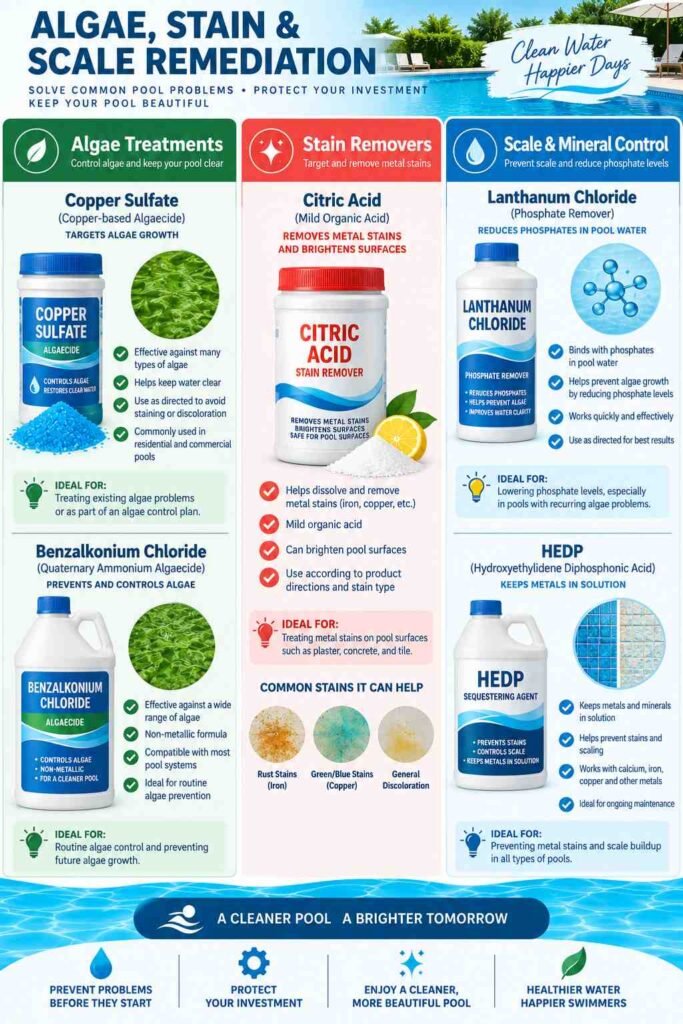
Specialized chemicals can be useful for pool algae, metal stains, mineral deposits, or conditions that encourage these problems.
These products are generally problem-specific treatments rather than chemicals that every pool needs as part of routine maintenance.
Copper Sulfate
It is a copper-based algaecide. Copper ions can interfere with algae growth, but excessive copper can contribute to metal staining.
For that reason, copper-based products should be used carefully and according to their specific label directions.
Benzalkonium Chloride
Benzalkonium chloride is a quaternary ammonium compound used in some algaecide formulations.
It provides a different method of algae control from chlorine and may be useful in specific treatment situations. Its application should be based on the product label and the type of algae problem being treated.
Lanthanum Chloride
Lanthanum chloride is commonly used in phosphate-removal products.
Phosphates can provide nutrients for algae, so reducing phosphate levels can remove one potential nutrient source. However, phosphate removal does not replace proper sanitation, circulation, filtration, or physical algae removal.
Citric Acid
Citric acid is a mild organic acid used in some treatments for metal-related stains.
It can help dissolve or loosen certain deposits, but stain identification is important because different stains may require different treatments.
Hydroxyethylidene Diphosphonic Acid (HEDP)
Hydroxyethylidene diphosphonic acid, or HEDP, is a sequestering agent.
Rather than directly removing metals from the water, HEDP helps keep certain metals and minerals in solution so they are less likely to form visible deposits or stains on pool surfaces.
Zinc Sulfate Monohydrate
Zinc sulfate monohydrate is used in some mineral-based algae-control products.
Its use depends on the formulation and intended application. Like other specialized algae treatments, it should be viewed as an additional treatment rather than a replacement for maintaining appropriate sanitation.
7. Enzymes & Specialty Maintenance
Some pool chemicals are designed to address contaminants or appearance problems that are not directly related to sanitation or basic water balance.
Natural/Synthetic Protease Enzymes
Protease enzymes are used in some pool-maintenance products to help break down organic contaminants such as body oils and lotions.
These products can support routine maintenance by reducing certain organic materials that enter the water. They do not replace sanitation, filtration, or proper chemical balance.
Polydimethylsiloxane
Polydimethylsiloxane (PDMS) is a silicone-based antifoam chemical.
It helps destabilize bubbles and reduce visible foam in pool water. Foam can be associated with soaps, cosmetics, surfactants, organic contaminants, or other conditions.
An antifoam product addresses the visible foam but does not necessarily correct the reason the foam developed.
How to Choose the Right Pool Chemical?
The right chemical depends on what the water test and visual inspection reveal. A cloudy pool, for example, could have an algae problem, poor filtration, suspended particles, or a chemical imbalance. Each situation calls for a different approach.
Start by testing the water and checking the main parameters relevant to your sanitation system. For a conventional outdoor chlorine pool, this generally includes free chlorine, pH, total alkalinity, calcium hardness, and cyanuric acid.
Pool volume also matters because chemical dosage is calculated according to the amount of water being treated. If the pool’s volume is uncertain, use a reliable pool volume calculator before making a major chemical adjustment.
Once the problem has been identified, select a chemical designed specifically for that purpose. Always use the dosage, application instructions, compatibility information, and safety requirements printed on the product label.
Do You Need Every Pool Chemical?
No. Most residential pool owners do not need every chemical described in this guide.
A conventional chlorine pool will typically need a sanitizer and products for adjusting pH and alkalinity. Depending on the water and pool surface, the owner may also need cyanuric acid or calcium hardness adjustment.
Specialized chemicals such as algaecides, flocculants, stain treatments, sequestrants, phosphate removers, enzymes, and antifoam products are generally used when a particular problem requires them.
Pool Chemical Safety
Pool chemicals require careful handling because some products are corrosive, oxidizing, or highly reactive.
Never mix pool chemicals unless the manufacturer specifically instructs you to do so. In particular, chlorine products and acids should never be mixed directly.
Keep chemicals in their original labeled containers and store them according to the manufacturer’s requirements. They should be kept away from children and pets and separated from incompatible products.
When handling concentrated chemicals, use the protective equipment specified on the product label. Good ventilation and careful measuring are also important when working with strong acids, bases, and oxidizers.
The CDC’s pool chemical safety guidance covers safe storage, protective equipment, chemical separation, and preventing accidental mixing.
If several chemical adjustments are needed, make them individually according to the appropriate instructions. Allow adequate circulation or treatment time and retest the water before deciding whether another adjustment is necessary.
Common Pool Chemical Mistakes
One common mistake is using chlorine to solve every pool problem. Chlorine is essential for sanitation, but it does not correct low alkalinity, low calcium hardness, excessive cyanuric acid, metal stains, or scaling.
It is also easy to confuse chemicals with similar purposes. Baking soda primarily raises alkalinity, while soda ash is primarily used to raise pH.
Cloudy water is another area where incorrect chemical selection is common. A clarifier may help suspended particles, but it will not correct every cause of cloudy water. Identifying the cause first leads to a more appropriate treatment.
Frequently Asked Questions
What are the most important pool chemicals?
For a typical residential chlorine pool, the core chemical needs are usually a sanitizer, pH adjuster, alkalinity adjuster, and, when appropriate, cyanuric acid and calcium-hardness products. Other chemicals depend on specific water conditions.
Is pool salt a chlorine-free sanitizer?
No. Saltwater chlorine generators use sodium chloride as the raw material for producing chlorine. A saltwater pool is still a chlorine-sanitized pool.
Is shock the same as chlorine?
No. Shock refers to a treatment intended to rapidly oxidize contaminants or increase sanitizer activity. Some shock products contain chlorine, while others use non-chlorine oxidizers such as potassium peroxymonosulfate.
What is the difference between clarifier and flocculant?
A clarifier helps fine particles become easier for the filter to capture, while a flocculant causes particles to combine and settle so they can be removed from the pool.
Does algaecide replace chlorine?
No. Algaecides are specialized algae-control products and should not generally be treated as replacements for the pool’s primary sanitizer.
Can pool chemicals expire?
Some pool chemicals can lose effectiveness over time, particularly when exposed to moisture, heat, or poor storage conditions. Check the manufacturer’s storage and shelf-life information for the specific product.