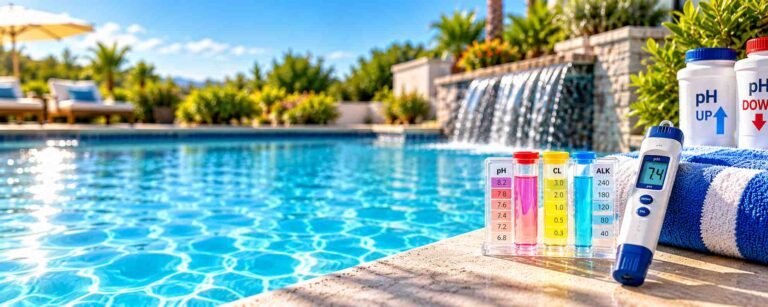
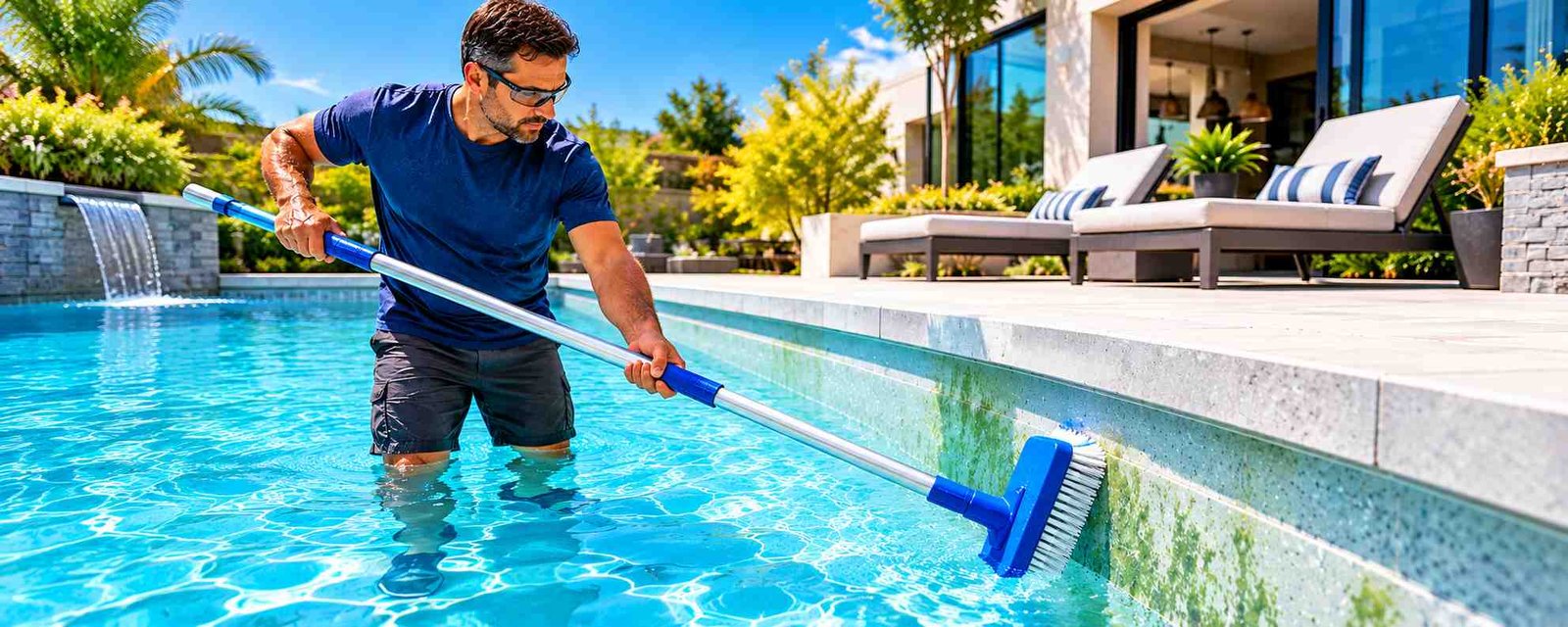
| Summary: Pool algae usually develops because of low sanitizer levels, poor circulation, filtration problems, or unbalanced water chemistry. Identify the algae type, test your water, brush affected surfaces, treat the pool, and clean the filter. Regular testing, sanitation, circulation, and maintenance help prevent algae from returning. |
Pool algae are one of the common pool problems. They are simple organisms that grow when water conditions support their development. They can enter pools through wind, rain, debris, and contaminated equipment.
Under the right conditions, algae can multiply quickly. Low sanitizer levels, warm water, sunlight, poor circulation, and weak filtration can all contribute.
Algae may appear as cloudy water or colored growth on pool surfaces.
Types of Algae in Pool Water
| Type | Appearance | Common Locations | Difficulty |
| Green algae | Green, slimy, or cloudy | Walls, floor, water | Usually, easier |
| Mustard algae | Yellow, tan, or brown | Shaded surfaces | Moderate |
| Black algae | Dark blue, green, or black spots | Porous surfaces | Difficult |

Green Algae
Green algae is the most common algae problem in residential pools. It can turn the water cloudy or green when growth becomes widespread.
It may also create a slimy coating on walls, floors, steps, and other surfaces. Poor sanitation often allows green algae to spread quickly.
Fortunately, green algae is generally easier to control than mustard or black algae.
Mustard Algae
Mustard algae is usually yellow, tan, or brown. It often develops on shaded walls, steps, and other protected surfaces.
It can return when treatment doesn’t address affected surfaces and equipment.
Recurring yellow or brown growth deserves closer attention.
Black Algae
Black algae appears as dark blue, green, or black spots. It often attaches firmly to pool surfaces.
Some black algae can establish itself deeper within porous finishes. Removing the visible portion may not completely solve the problem.
This type can require more persistent cleaning and sanitation than ordinary green algae.
Don’t Be Confused
Sometimes, pool owners consider pink slime and white water mold as algae but it’s not true. Identifying the correct problem is the first step toward choosing the right treatment.
Pink Algae
Pink slime is commonly associated with bacteria rather than true algae. It can appear as pink or reddish material around fittings and pool surfaces.
Poor circulation and sanitation can contribute to its development. Treatment should address the affected areas and underlying maintenance problems.
White Water Mold
White water mold can resemble pieces of white tissue or shredded material. It may float through the water or collect around equipment.
Although it is often called mold, it isn’t the same as household mold. Avoid assuming every white substance requires an algae treatment.
What Causes Algae in Pools?
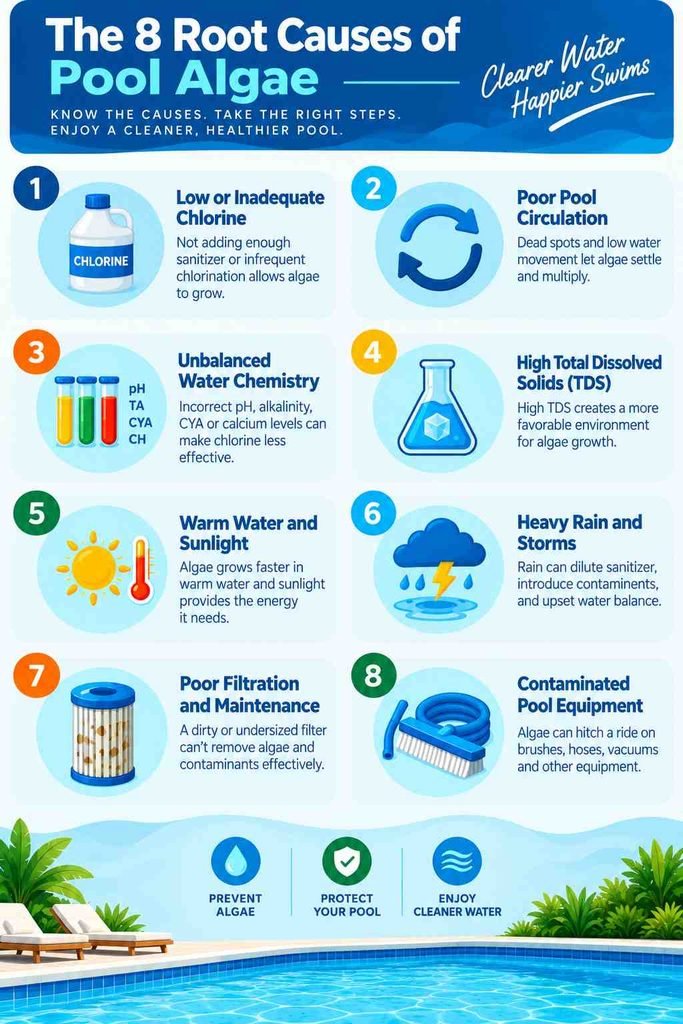
Low or Inadequate Chlorine
When chlorine is not added or maintained as part of the normal pool-care routine, sanitizer levels can fall too low. This gives algae an opportunity to establish itself, especially when the pool is used often or exposed to heavy debris.
Once algae becomes established, normal maintenance doses may not be enough to remove it. The pool may then need a more thorough treatment and cleaning process.
Poor Pool Circulation
Good circulation distributes treated water throughout the pool. However, some areas naturally receive less water movement than others.
Corners, steps, ladders, and areas behind fittings can become low-flow zones. Algae may develop in these locations first.
If algae repeatedly appears in one area, check the circulation pattern. Make sure return jets, the pump, and filtration system are working properly.
Before making chemical changes, confirm your pool size with the pool volume calculator so treatment estimates use the right water volume.
Unbalanced Water Chemistry
Pool water chemistry can also create problems even when chlorine is present. For many residential pools, pH is commonly maintained between 7.0 and 7.8. When pH moves too high, chlorine becomes less effective.
If testing shows that free chlorine needs adjustment, use the pool chlorine calculator to estimate the amount for your pool and chosen product.
Cyanuric acid, often called CYA, protects chlorine from sunlight. However, excessive CYA can change chlorine’s effectiveness and may require a different management approach.
High Total Dissolved Solids (TDS)
High total dissolved solids (TDS) do not directly cause algae, but they can signal that dissolved salts, minerals, and other substances have built up in the water. Elevated TDS can also occur alongside other water-quality problems. If algae keeps returning, check TDS along with sanitizer, pH, alkalinity, circulation, and filtration.
Warm Water and Sunlight
Algae generally grows faster when water becomes warm. Sunlight can also increase chlorine demand, especially during hot summer weather.
Warm water alone doesn’t cause an algae outbreak. Good sanitation and circulation can keep algae under control.
Heavy Rain and Storms
Rain can introduce organic debris and contaminants into your pool. It can also dilute chemicals and affect water balance.
Storm runoff may create additional problems when dirty water enters the pool.
Poor Filtration and Maintenance
A dirty filter may reduce filtration performance and allow suspended material to remain in the water. During an algae outbreak, filters can become dirty even faster.
Infrequent brushing and vacuuming can also allow algae and debris to remain on surfaces.
Contaminated Pool Equipment
Pool brushes, vacuum heads, hoses, and other equipment can carry algae between surfaces. This becomes especially important after a serious algae outbreak.
Mustard algae can be particularly troublesome because contaminated equipment may help spread it again.
Real-World Diagnostic Comparisons
To choose the right treatment, you must distinguish true algae from common environmental debris:
Algae vs. Dirt
Dirt generally settles on surfaces and can often be removed easily with brushing or vacuuming. Algae tends to cling to surfaces or create a slippery coating.
Mustard algae can make this comparison difficult. If yellow or brown material repeatedly returns, investigate your water chemistry and sanitation.
Pool Algae vs. Pollen
Pollen commonly floats on the water or collects along the pool edges. It can look yellow and dusty during high-pollen seasons.
Mustard algae may look similar, but it usually sticks to pool surfaces. Location and behavior can help distinguish the two.
Algae vs. Mold
Algae often appears green, yellow, brown, or black. White water mold can instead look like wet tissue or floating flakes.
Consider color, texture, and location together. Don’t automatically treat every unusual pool substance as algae.
How to Get Rid of Algae in a Pool

Algae treatment works best when you address both the visible growth and the conditions supporting it. Simply adding pool chemicals may provide temporary improvement.
Step 1: Test the Pool Water
Test before adding chemicals. Measure free chlorine, pH, alkalinity, and cyanuric acid with a suitable pool test kit. The CDC explains how to test and treat home pool water and why regular checks matter.
Step 2: Remove Physical Debris
Scoop out all leaves, insects, and organic material using a skimmer net. Clogged skimmer and pump baskets must be emptied immediately to maximize water flow. Organic matter consumes chlorine; removing it allows your shock to target the algae directly.
Step 3: Brush Affected Surfaces
You must physically break down the algae’s protective biofilm so chemicals can reach the spores. Brush the walls, floors, steps, and tight corners thoroughly.
Expert Tip: If dealing with black algae, you must use a stiff stainless steel wire brush (for plaster/concrete) to scrape the top off every single black spot to crack its waxy coat before applying chemicals.
Step 4: Vacuum the Pool
Vacuum the pool carefully to remove all loosened algae and debris.
Expert Tip: Never use an automatic pool cleaner or vacuum through your standard “Filter” setting for heavy green algae blooms. This will instantly clog your filter or send fine, dying algae particles shooting right back into your pool water. Set your multiport valve to “Waste” and use a manual vacuum to discharge the algae out of the pool entirely.
Follow the manufacturer’s instructions for your system.
Step 5: Correct Water Chemistry
Adjust your pH so it sits between 7.2 and 7.4. Chlorine loses more than half of its sanitizing strength if your pH rises above 7.8, making your shock treatment useless.
After testing, the pool pH calculator can help you estimate a pH adjustment.
Step 6: Shock Treatment
Add a heavy dose of calcium hypochlorite (cal-hypo) or liquid chlorine to destroy the remaining spores.
Dosage Rule: Double shock for green algae (2 lbs per 10,000 gallons), triple shock for mustard algae (3 lbs), and quadruple shock for black algae (4 lbs) paired with directly rubbing a chlorine tablet on the roots.
Follow the product label carefully. Never mix pool chemicals unless the manufacturer specifically permits it. Review the EPA’s safe storage and handling guidance for swimming pool chemicals before treating the pool.
Some algae problems may also involve an algaecide. It should complement proper sanitation rather than replace it.
Step 7: Run the Filtration System
Turn your pump and filtration system on and run it 24/7 until the water turns completely crystal clear. Do not rely on automated daily timers during an outbreak.
Step 8: Clean the Filter
A filter-cleaning product can help remove buildup from compatible filter media. Always check that the cleaner is designed for your filter type.
Inspect your filter during and after treatment. A heavily loaded filter may need cleaning before it can continue working effectively.
Sand and DE filters may require backwashing. Cartridge filters generally require removal and cleaning.
Always follow the instructions for your specific filter.
Step 9: Retest and Inspect
Retest your water chemistry and inspect all shaded areas, ladders, and fittings for leftover patches. If the water is clear but your free chlorine levels drop significantly overnight, algae is still actively hiding in the system.
Step 10: Return to Normal Maintenance
Soak your pool brushes, vacuum hoses, and bather swimwear inside the treated pool water. If you skip this, a single microscopic spore clinging to your pool equipment will reinfect the water next week. Once cleared, return to your standard maintenance routine.
How to Prevent Pool Algae
- Test pool water at least twice a week to maintain proper sanitizer and pH windows.
- Keep free chlorine at a minimum of 1 ppm without CYA, or 2 ppm when using CYA.
- Angle your return jets downward and in a circular pattern to eliminate stagnant water zones.
- Brush pool walls and floors at least once a week, even if the pool looks completely clean.
- Run your filtration system for a minimum of 8 to 12 hours a day during hot summer months.
Common Pool Algae Treatment Mistakes
Adding Chemicals Without Testing
Adding chemicals without testing can create unnecessary water chemistry problems. Test your water before making significant chemical adjustments.
Ignoring Pool Surfaces
Algae can remain attached to walls, floors, steps, and fittings. Clear-looking water doesn’t always mean the problem is completely gone.
Brush affected surfaces and inspect areas where growth previously appeared.
Stopping Treatment Too Early
A pool can look much better before the algae problem is fully resolved. Retest the water and inspect the surfaces before ending treatment.
Treating Only Visible Growth
Visible algae may not represent the entire problem. Growth can remain in shaded areas or on equipment.
Inspect the entire pool and cleaning equipment, especially when dealing with recurring mustard algae.
Frequently Asked Questions About Pool Algae
What Causes Algae in a Pool?
Low sanitizer levels are a common cause of pool algae. However, poor circulation, warm water, poor filtration, and weak maintenance can also contribute. Check the entire pool system when algae appears.
Why Does Pool Algae Keep Coming Back?
Recurring algae usually indicates that some growth or underlying problem remains. Low sanitizer, poor circulation, and inadequate filtration are common factors. Contaminated equipment can also contribute.
Can Algae Grow in a Saltwater Pool?
Yes, saltwater pools can develop algae. Saltwater systems generate chlorine, but the pool still requires proper sanitation. Low chlorine production or poor water management can allow growth.
For saltwater pool upkeep, the pool salt calculator can help estimate salt adjustments when tests show they are needed.
How Long Does It Take to Remove Pool Algae?
Treatment time depends on the algae type and severity. Water chemistry, circulation, filtration, and cleaning also affect the process. Stubborn algae can require repeated treatment.
Can You Swim in a Pool with Algae?
Swimming in a pool with visible algae is generally not recommended. Algae can make surfaces slippery and may indicate inadequate sanitation. Wait until treatment is complete and water chemistry is appropriate.