| Summary: Cleaning salt cell swimming pool equipment is an important part of maintaining a saltwater pool’s chlorine generator. Calcium deposits and mineral scale can build up on the cell plates, potentially affecting chlorine production and water flow. Inspect the cell, switch off the equipment, rinse away loose deposits if the manufacturer permits it, and use an approved cleaning solution only when necessary. |
Cleaning a salt cell helps remove calcium buildup that can affect chlorine production and water flow. In this guide, you will learn how to inspect your saltwater chlorinator, clean the plates safely, and prevent future scale buildup to keep your pool running efficiently.
What Is a Salt Cell and Why Does It Need Cleaning?
A salt cell is part of a salt chlorine generator, also called a saltwater chlorinator. It uses electrolysis to convert dissolved salt into chlorine that helps keep pool water clean. Calcium and other minerals can collect on the plates, especially when pH or calcium hardness is high. Scale may restrict flow or affect generator performance, but a warning can also point to low salt, circulation problems, or another equipment issue. Inspect the cell before deciding it needs a chemical cleaning.
Signs Your Swimming Pool Salt Cell Needs Cleaning
Look for white, chalky deposits on the plates, a cell inspection warning, reduced chlorine production, or recurring alerts. These signs do not prove scale is the cause, so check water chemistry and troubleshoot the system before cleaning. Test chlorine with a reliable kit rather than relying only on the generator display. Pool Viva’s Pool Chlorine Calculator can help estimate chlorine additions when adjustments are necessary.
What You Need to Clean a Salt Chlorine Generator Cell
Gather protective chemical-resistant gloves and goggles, a garden hose with a gentle spray, the manufacturer-approved cleaning stand or cap if required, an approved cleaning solution only if specified, and the equipment manual. Exact supplies vary by model. A compatible kit may help, but never use metal brushes, screwdrivers, or sharp tools on the plates.
Cleaning Salt Cell Swimming Pool Equipment Step by Step
Step 1: Turn Off the Salt System and Pool Pump
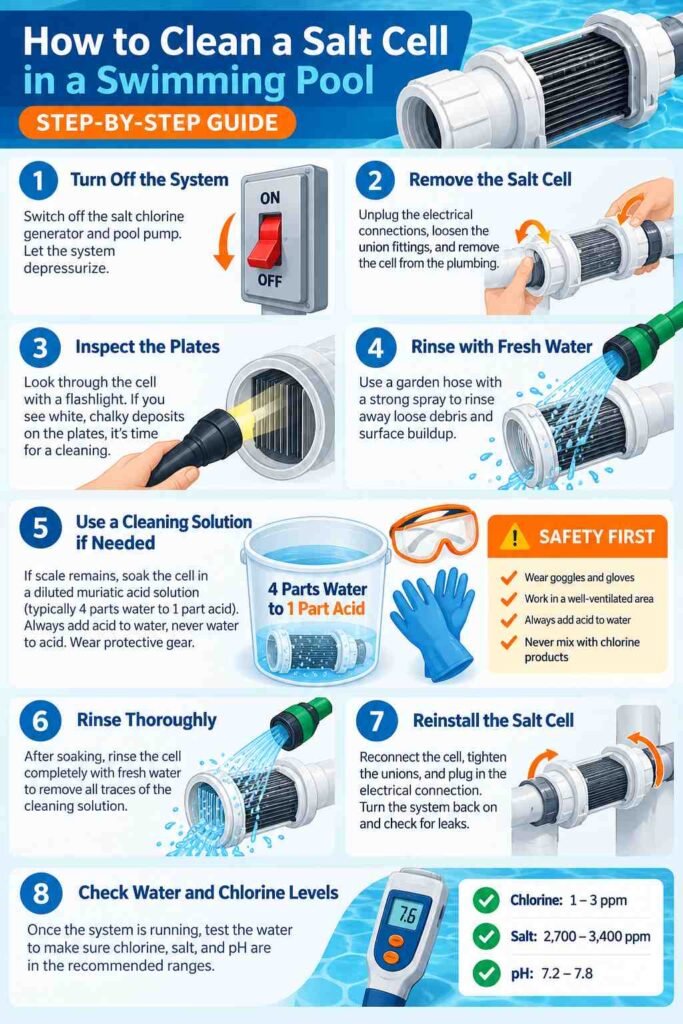
Switch off the salt generator and pool pump, and isolate electrical power as required for your setup. Allow the system to depressurize fully before opening plumbing connections. Never loosen a cell union while the system is running or pressurized. If you are unsure how to isolate the equipment safely, contact a qualified technician.
Step 2: Remove the Salt Cell
Locate the cell near the filtration equipment. With power off and pressure released, disconnect the cell, unplug electrical connections as required, loosen the unions, and remove the cell without pulling on its cable. Keep track of seals and fittings. Inspect the housing and connections for cracks or damaged seals.
Step 3: Inspect the Cell Plates
Look through the cell, using a flashlight if needed, to check for white mineral deposits. Light residue may not require chemical cleaning. If the plates look relatively clean, check the troubleshooting guidance before proceeding. Cleaning a cell that has little scale can wear down its catalytic coating and shorten its lifespan. Cleaning also cannot repair damaged plates.
Step 4: Rinse Away Loose Deposits
Rinse the cell with fresh water and a gentle hose spray if this is allowed for your model. Avoid electrical connectors, do not insert tools between plates, and do not scrape stubborn deposits. Inspect again; if loose scale is gone, chemical cleaning may not be needed.
Step 5: Use an Approved Cleaning Solution if Necessary
Important: This solution can eat away at the cell plates’ catalytic coating if it is too strong or left in place too long. Follow the directions for your exact cell rather than relying on a generic ratio or soak time.
Some cells require a diluted muriatic-acid solution to remove stubborn calcium scale, while others specify a different method. Confirm that your exact model supports this treatment and use its stated dilution and contact time. A 4-parts-water-to-1-part-muriatic-acid mixture appears in some manufacturer instructions, but it is not a universal recipe. Work in a well-ventilated area, keep children and pets away, and wear the protective equipment listed on the product label. If dilution is required, add the product to water, never water to the product. Never mix it with chlorine products, bleach, or other pool chemicals; contact with chlorine residue can release toxic chlorine gas. Rinse the cell as directed before cleaning.
Step 6: Rinse the Cell Thoroughly
Rinse the cell thoroughly to flush away the solution and loosened deposits. Do not leave cleaning solution inside longer than directed. Dispose of used solution according to its label and local requirements; never mix it with leftover pool chemicals. If deposits remain, confirm that another cleaning cycle is permitted before repeating treatment.
Step 7: Reinstall the Salt Cell
Reinstall the cell as directed. Make sure seals are seated, reconnect plumbing without overtightening, reconnect the cable as instructed, and confirm correct orientation. Restart the system using the prescribed procedure and check for leaks. If you notice a leak, unusual noise, or persistent warning, switch the system off when safe and troubleshoot before normal operation.
Step 8: Check Chlorine Production and Water Chemistry
Check the control panel and test the water. Confirm free chlorine and pH are within the ranges recommended for your pool and system. If chlorine production remains low, check salt concentration, water temperature, circulation, filter condition, chemistry, and cell condition. Use the troubleshooting section for your generator if the warning persists.
Use a pool salt calculator to estimate salt additions only when testing confirms the level needs adjustment. For pH adjustments, see the pool pH calculator. Always verify pool volume and follow chemical labels.1
How Often Should You Clean a Salt Cell?
There is no universal cleaning schedule. Frequency depends on the model, water chemistry, operating conditions, and scale buildup. Some systems reverse polarity to reduce deposits, but inspection is still important. Inspect on the recommended schedule, clean when the cell has meaningful scale, monitor salt, pH, and calcium hardness, and keep maintenance records. Cleaning a cell that does not need it can damage the plates.
Common Salt Cell Cleaning Mistakes to Avoid
Cleaning the Cell Too Often
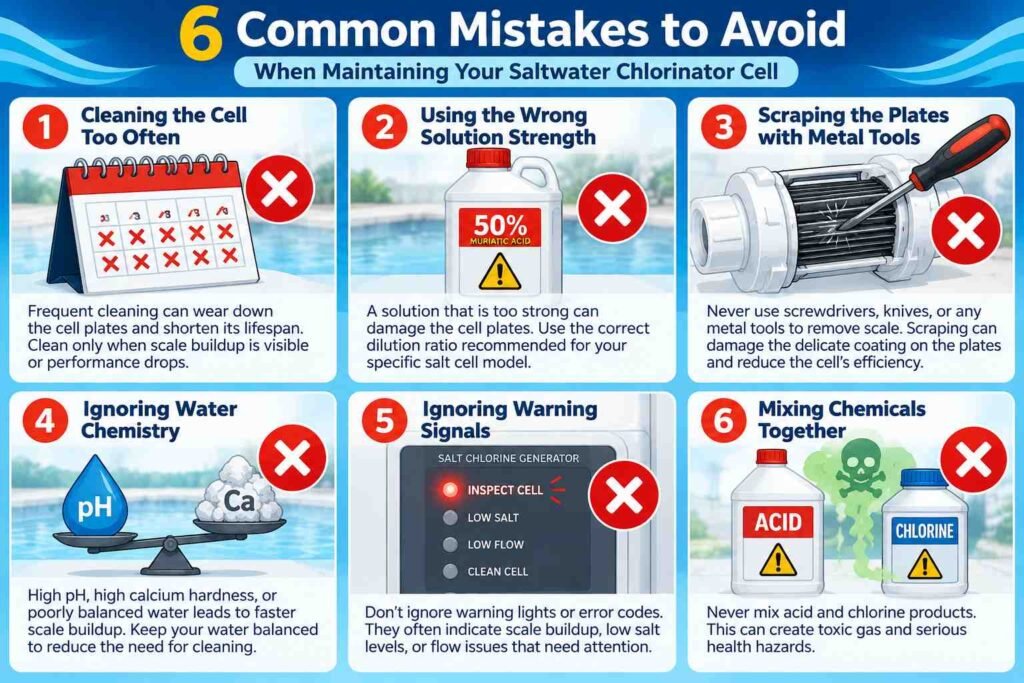
Repeated chemical cleaning can wear down the cell coating. Inspect first and clean only when necessary.
Using the Wrong Cleaning-Solution Concentration
A stronger solution does not necessarily clean better. Excessive concentration or contact time can damage the cell.
Scraping Calcium Off the Plates
Metal tools and sharp objects can damage the plates. Use only manufacturer-approved methods.
Ignoring Water Chemistry
Elevated pH and high calcium hardness can contribute to scale. Cleaning without addressing the cause may allow deposits to return.
Assuming Every Warning Means a Dirty Cell
Low salt, poor flow, cold water, or equipment faults can trigger alerts. Troubleshoot before cleaning again.
Mixing Pool Chemicals
Never combine the cleaning solution with chlorine products or other pool chemicals. Contact with chlorine residue can release toxic chlorine gas. Keep chemicals in their original labeled containers and store them separately.
How to Prevent Calcium Buildup on a Salt Cell
Maintain pH within the recommended range, monitor calcium hardness, and keep salt within the generator’s operating range. Avoid adding salt unless testing confirms it is needed. Keep circulation working, clean the filter when required, and follow the generator’s inspection schedule. For routine upkeep, visit Pool Viva’s pool cleaning and maintenance guide.
Frequently Asked Questions
Can I clean a salt cell with vinegar?
Vinegar is not a universal fix for salt cells. Some manufacturers allow a vinegar-based cleaning method, but others specify a different approach. Use vinegar only if the instructions for your exact cell permit it, and follow the stated concentration and contact time. Do not assume that an undiluted, multi-hour soak is safe for the cell plates.
Can I clean a salt cell without removing it?
Usually, the cell needs to be removed so you can inspect the plates and clean them properly. Never try to loosen or service a cell while the system is running or pressurized.
What happens if I never clean my salt cell?
Heavy scale can restrict flow or interfere with chlorine production. Inspect the plates periodically and clean when buildup warrants it; unnecessary chemical cleaning can shorten the cell’s life.
Why does my salt cell keep showing an inspection warning after cleaning?
A warning can point to low salt, poor circulation, cold water, a settings issue, or a failing cell—not just scale. Check salt and water flow, then use the generator’s troubleshooting guide before cleaning it again.
Should I clean a salt cell every three months?
No. Some cells need cleaning less often, while others build up scale sooner. Inspect on schedule and clean only when buildup warrants it.
Does cleaning a salt cell improve chlorine levels?
It may help if scale was affecting performance, but low chlorine can have other causes. Check salt, circulation, chemistry, settings, and cell condition.