| Summary: Balanced pool water depends on pH, chlorine, alkalinity, cyanuric acid, calcium hardness, temperature, and dissolved solids. Test regularly, correct the biggest imbalance first, and follow each product label. Good circulation and filtration also support clear, healthy water. |
What Is Pool Chemistry?
Pool chemistry is the balance of chemicals and dissolved minerals in swimming pool water. These levels affect sanitation, clarity, swimmer comfort, surfaces, and equipment.
Clear water does not always mean balanced water. Therefore, regular testing gives you a much better picture than appearance alone.
The main readings for most residential pools include pH, free chlorine, total alkalinity, cyanuric acid, and calcium hardness. Temperature and total dissolved solids also influence the overall water balance.
Why Balanced Pool Water Matters
Balanced water helps chlorine sanitize effectively and reduces conditions that can damage pool surfaces and equipment.
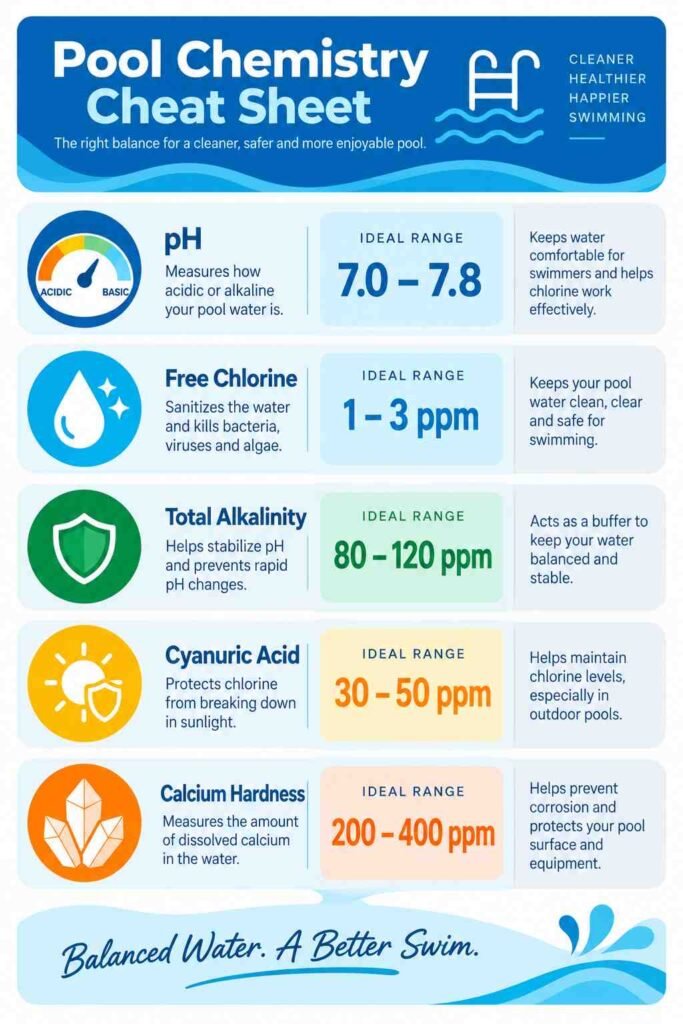
The CDC recommends a pH of 7.0 to 7.8 for pools. It also recommends at least 1 ppm free chlorine without cyanuric acid.
When cyanuric acid is used, the CDC recommends at least 2 ppm free chlorine. Your sanitizer label may provide a specific operating range.
Good chemistry also reduces the chance of scale, corrosion, cloudy water, and recurring sanitation problems.
Pool Chemistry at a Glance
| Parameter | What It Tells You |
| pH | How acidic or alkaline the water is |
| Free Chlorine | Available sanitizer |
| Total Alkalinity | Resistance to pH changes |
| Cyanuric Acid | Protection of chlorine from sunlight |
| Calcium Hardness | Dissolved calcium level |
| TDS | Total dissolved substances |
| LSI | Calcium-carbonate balance |
Understanding the Main Parts of Pool Water Chemistry
Pool pH
pH measures how acidic or alkaline your pool water is. It affects chlorine performance, swimmer comfort, and equipment condition.
The CDC recommends keeping pool pH between 7.0 and 7.8. Many maintenance programs use a narrower target within that range. Use the pool pH calculator to estimate the adjustment needed, then follow the chemical label.
Because pH interacts with other water factors, test it before making a chemical adjustment.
What Happens When pH Is Too High?
High pH can reduce the effectiveness of chlorine. It can also contribute to cloudy water and mineral scale.
Scale may appear around heaters, fittings, tile, and other surfaces when conditions favor calcium carbonate deposits.
Check total alkalinity as well when pH repeatedly rises.
What Happens When pH Is Too Low?
Low pH makes the water more acidic. Over time, this can increase corrosion risks and may irritate swimmers.
Test the water before adding a pH increaser. A measured correction is safer than repeated chemical additions.
Free Chlorine
Free chlorine is the portion of chlorine available to sanitize pool water. It helps control bacteria, algae, and other contaminants introduced by swimmers and the environment. Its effectiveness depends on factors such as pH and cyanuric acid, so chlorine should always be evaluated with the rest of the water chemistry.
Total Alkalinity
Total alkalinity measures the water’s ability to resist changes in pH. It acts as part of the buffering system that helps keep pH more stable.
When alkalinity is too low, pH can change quickly. When it is too high, pH can become harder to lower.
Many residential pool programs use about 80–120 ppm as a working range. However, the best target can vary with the pool and maintenance method.
Carbonate Alkalinity vs. Total Alkalinity
Total alkalinity includes several alkaline substances. Bicarbonate and carbonate are especially important to calcium-carbonate balance.
This distinction matters because alkalinity is used in saturation calculations. Therefore, a single alkalinity number does not tell the whole chemistry story.
For everyday maintenance, total alkalinity remains the practical measurement most homeowners monitor.
Cyanuric Acid
Cyanuric acid, often called CYA, helps protect chlorine from ultraviolet sunlight. It is common in outdoor pools.
However, CYA changes how chlorine behaves in water. Therefore, chlorine targets need to account for its presence.
Stabilized chlorine products can add CYA over time. Regular testing helps prevent unwanted buildup.
Calcium Hardness
Calcium hardness measures dissolved calcium in pool water. The level matters because calcium can either remain dissolved or form deposits.
Low calcium can contribute to aggressive water conditions. High calcium can increase the risk of scale.
Many residential pools use about 200–400 ppm as a working range. Surface type and local water conditions can change the preferred target.
What Is Total Dissolved Solids (TDS)?
Total dissolved solids (TDS) represent the dissolved substances present in pool water. They can include salts, minerals, treatment chemicals, and other dissolved materials. Evaporation removes water but leaves these substances behind, so TDS can increase over time. TDS alone doesn’t determine whether water is safe or balanced, but unusually high levels can signal that water replacement deserves consideration.
What Is the Langelier Saturation Index (LSI)?
The Langelier Saturation Index (LSI) helps show whether pool water may dissolve or deposit calcium carbonate. It considers pH, water temperature, calcium hardness, alkalinity, and dissolved solids. A negative LSI indicates more aggressive water, while a positive value indicates a greater scale-forming tendency. Near-zero readings indicate a closer calcium-carbonate balance.
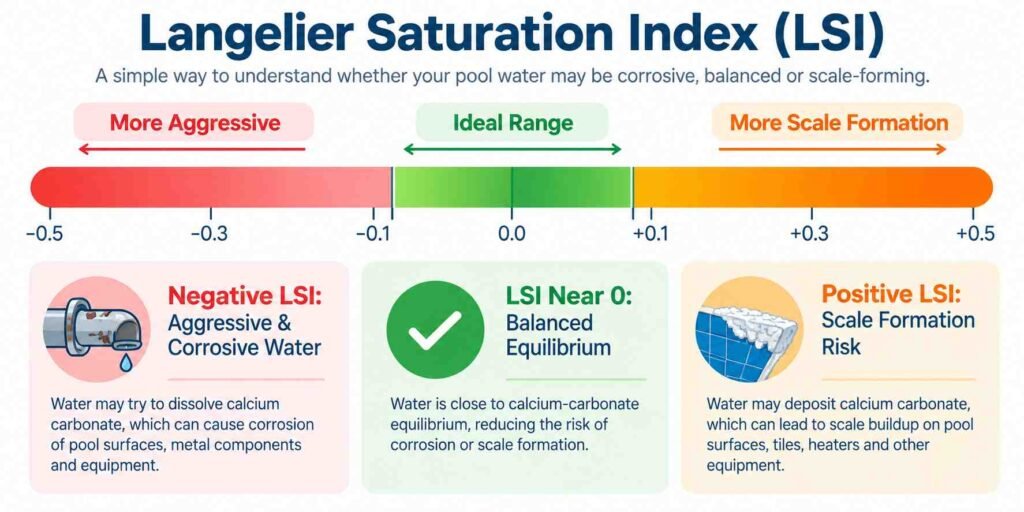
| LSI Reading | General Indication | Practical Impact on Your Pool |
| Below -0.1 | More Aggressive / Negative LSI | Water is undersaturated. It may try to dissolve calcium, causing corrosion to pool surfaces, metal components, and equipment. |
| -0.1 to +0.1 | Ideal Range / Near 0 | Water is in a balanced equilibrium. This minimizes the risk of both scale formation and equipment corrosion. |
| Above +0.1 | More Scale Formation / Positive LSI | Water is oversaturated. It may deposit calcium carbonate, leading to crusty scale buildup on tiles, pool surfaces, and heaters. |
How Chlorine Actually Sanitizes Pool Water
Chlorine does more than provide a number on a test kit. Its chemistry determines how effectively it can control microorganisms in water.
When chlorine enters water, it establishes an equilibrium that includes hypochlorous acid (HOCl) and hypochlorite ion (OCl⁻).
HOCl is the more effective disinfecting form. The balance between these forms changes as pH changes.
As pH rises, the proportion of HOCl decreases. Therefore, a pool can show an acceptable chlorine reading while having less of its chlorine in the faster-acting form.
This is why pH and chlorine should be considered together rather than treated as completely separate measurements.
Free Chlorine and Combined Chlorine
Free chlorine is the chlorine available for sanitation. Combined chlorine forms when chlorine reacts with contaminants in the water.
A high combined chlorine reading can indicate that the pool needs attention. Strong chlorine odor can also be associated with chloramines.
Test results provide a better guide than smell alone.
What Reduces Chlorine?
Sunlight can consume chlorine, especially in outdoor pools. Swimmers also introduce sweat, dirt, and other contaminants.
Rain, debris, and algae can increase sanitizer demand. Heavy use can therefore change chlorine levels quickly.
If chlorine repeatedly disappears faster than expected, investigate the cause instead of simply adding larger doses.
How Much Chlorine Should a Pool Have?
The CDC recommends at least 1 ppm free chlorine in pools without cyanuric acid and at least 2 ppm when cyanuric acid is used. Always follow the operating range and safety directions on your specific sanitizer product.
Pool Acids and pH-Lowering Chemicals
Muriatic Acid (Hydrochloric Acid)
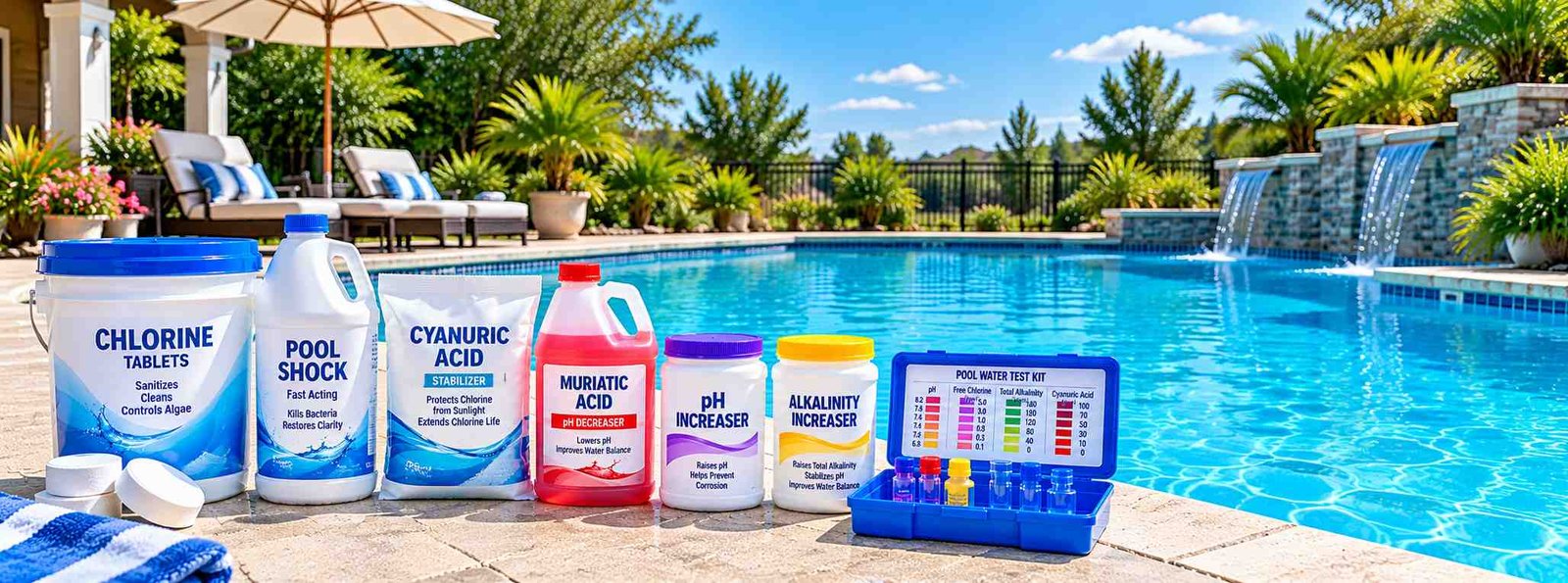
Muriatic acid is a common pool product used to lower pH. It can also reduce total alkalinity when applied as part of a controlled adjustment.
Pool-grade muriatic acid is a hydrochloric acid solution. Product concentrations can differ, so read the label before calculating a dose.
It is a strong chemical. Use the required protective equipment and follow the label for handling, storage, application, and first aid.
Never mix muriatic acid with chlorine products. Dangerous gases can form when incompatible pool chemicals are combined.
Dry Acid
Dry acid usually refers to sodium bisulfate. It provides another way to lower pool pH.
Like other pool chemicals, its concentration and dosage vary by product. Follow the manufacturer’s instructions.
Baking Soda
Baking soda is sodium bicarbonate. It is commonly used to raise total alkalinity.
It has a smaller effect on pH than soda ash. Therefore, it is usually chosen when alkalinity needs more attention than pH.
Test before adding it, then use the product instructions or a reliable dosage calculation.
Soda Ash
Soda ash, or sodium carbonate, raises pH more strongly than baking soda. It also increases total alkalinity. Because of that, test both readings before choosing it for a correction.
Pool Shock
Pool shock provides a concentrated sanitizer treatment for specific situations. Different shock products contain different active ingredients.
Some stabilized products can add cyanuric acid. Therefore, check the label before choosing a shock treatment.
Heavy swimmer use, algae growth, contamination, or elevated combined chlorine can indicate that additional treatment may be needed.
Saltwater Pool Chemistry
A saltwater pool still uses chlorine. A salt chlorine generator creates chlorine from dissolved salt.
The generator does not remove the need for testing. You still need to monitor chlorine and pH. Use the pool salt calculator to know the exact salt adjustment when the system requires more salt.
Depending on the system, also monitor salt concentration, alkalinity, CYA, and calcium hardness.
Does Salt Replace Chlorine?
No. Salt is used by the generator to produce chlorine. The resulting chlorine performs the sanitation work.
How to Test Pool Water
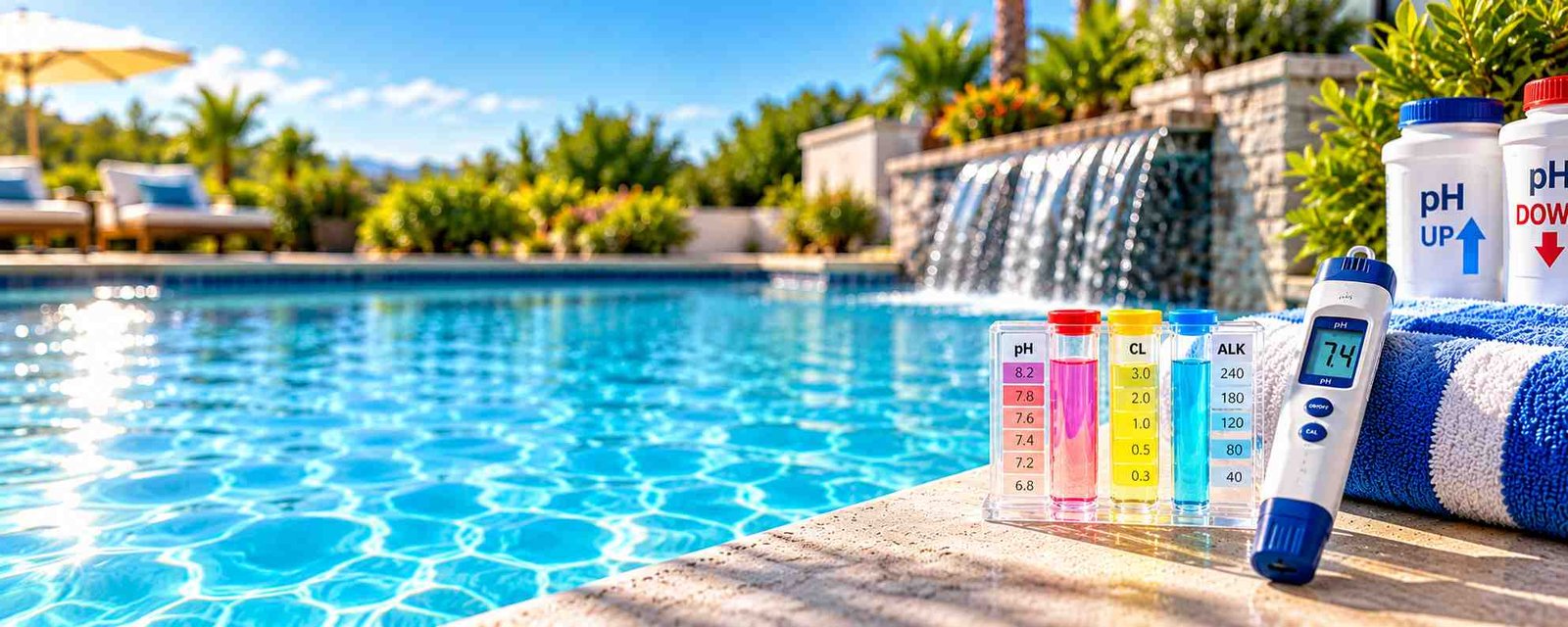
Homeowners can test water with strips, liquid kits, digital testers, or professional testing services.
The CDC recommends DPD-based testing for more accurate chlorine measurements. Test strips are convenient for routine checks but can be less precise.
For a complete picture, test pH and free chlorine regularly. Check alkalinity, CYA, and calcium hardness according to your maintenance routine.
Basic Testing Process
- Collect the sample according to your test kit instructions.
- Test free chlorine and pH.
- Check alkalinity, CYA, and calcium hardness when needed.
- Record the results before making chemical changes.
- Retest after the water has circulated.
When Should You Test Pool Water?
The CDC recommends testing chlorine and pH at least twice daily for home pools. More frequent checks may be useful after heavy rainfall, high swimmer use, algae treatment, or major chemical adjustments.
How to Balance Pool Water Step by Step
There is no single chemical dose that works for every pool. Your water volume, current readings, target range, and product strength all matter. A pool chemical calculator can make the calculations easier when the required inputs are known.
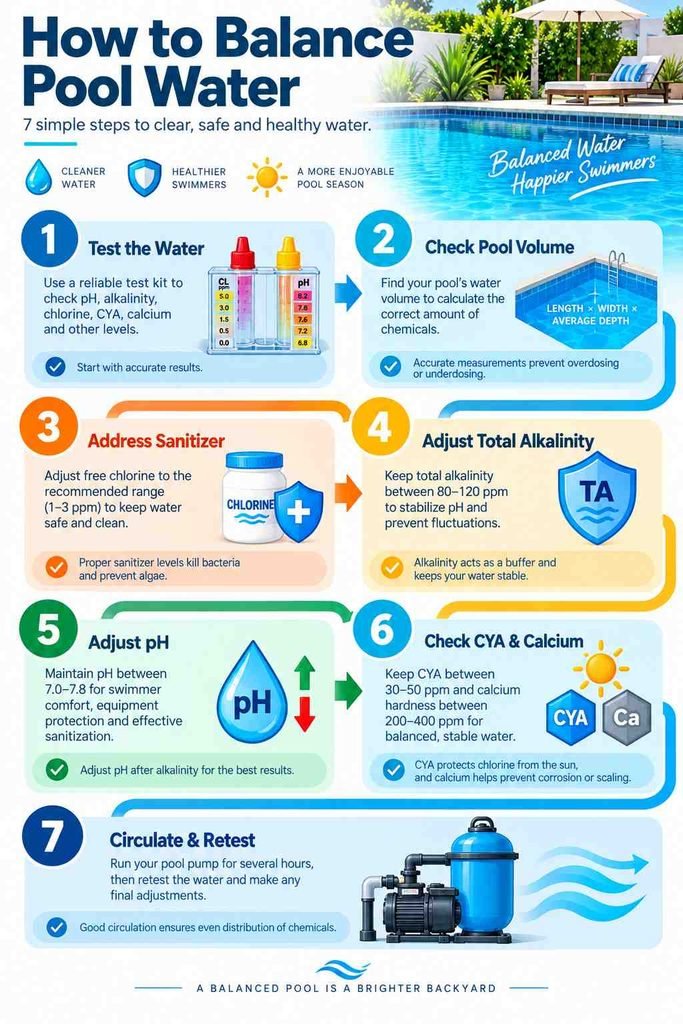
Step 1: Test the Water
Start with reliable measurements. Check sanitizer and pH first, then review the other readings.
Step 2: Check Pool Volume
Accurate volume matters because chemical dosage depends on the amount of water being treated. Use the pool volume calculator to know your pool’s capacity before calculating chemical doses.
Step 3: Address Sanitizer Problems
If sanitizer is inadequate, correct it according to your test results and product instructions. Use the pool chlorine calculator to know the adjustment needed from your current and target chlorine levels.
Step 4: Check and Adjust Total Alkalinity
When alkalinity is significantly out of range, address it before fine-tuning pH. Proper alkalinity helps resist rapid pH changes. Use the pool alkalinity calculator to know the adjustment needed for your pool.
Step 5: Adjust pH
Once alkalinity is in a suitable range, check pH again. Make a measured correction if needed.
Step 6: Check CYA and Calcium Hardness
Review these levels regularly. Correct them when readings fall outside the range appropriate for your pool.
Step 7: Circulate and Retest
Allow the pool to circulate before testing again. Compare the new readings with the original results.
How Much Pool Chemical Should You Add?
Chemical dosage depends on pool volume, current chemistry, target chemistry, and product concentration. Use the pool chemical calculator to know the adjustment needed based on your test results.
Never copy a dose from another pool without checking those factors.
A calculator can make the math easier, but it should support the product label rather than replace it.
Common Pool Chemistry Problems
Cloudy Pool Water
Test chlorine and pH first. Then inspect filtration and circulation before adding specialty products.
Green Pool Water
Green water commonly indicates algae. Check sanitizer levels and inspect circulation, filtration, and pool surfaces.
High Pool pH
High alkalinity and aeration can contribute to repeated pH increases. Test both readings before adding acid.
Low Pool pH
Low pH can follow acidic chemical additions or other changes. Test before adding a pH increaser.
High Chlorine
High chlorine can follow shock treatment or excessive dosing. Verify the reading before adding more sanitizer.
Pool Chemical Safety
Keep pool chemicals in their original containers. Store them according to their labels.
Never mix chlorine products with acids. The combination can release dangerous gases.
The EPA warns that improper handling or mixing of pool chemicals can cause toxic exposures, fires, and other serious hazards.
Follow label directions for protective equipment, storage, application, and first aid.
Pool Chemical Storage
Keep containers closed when not in use. Protect products from moisture and sunlight when the label requires it.
Keep incompatible chemicals separated. Store them away from children, pets, heat sources, and ignition sources.
Can You Add Two or More Pool Chemicals at the Same Time?
Some chemicals can be used during the same maintenance session, but that does not mean they should be mixed. Follow product instructions and add chemicals separately when required. Never combine concentrated chemicals unless the manufacturer specifically instructs you to do so.
How Long Should You Wait After Adding Chemicals?
The waiting period depends on the product and treatment. Follow the label instructions and test the water before swimming, especially after shock treatments or major chemical adjustments.
Pool Chemistry Maintenance Schedule
Every Pool Day
Check the water when conditions require it. Look for unusual color, cloudiness, debris, or visible growth.
Every Week
Review your main chemistry readings, remove debris, inspect circulation, and brush or vacuum as needed.
Periodically
Check CYA and calcium hardness. Inspect the filter and review chemical use for unusual changes.
Pool Water Chemistry and Algae
Water balance plays a major role in algae prevention. However, algae can result from several conditions working together. Low sanitizer, poor circulation, inadequate filtration, warm conditions, and contaminated surfaces can all contribute.
Pool Water Chemistry and Pool Equipment
Incorrect pH can contribute to corrosion or scale. High calcium levels can also increase scaling risk when other conditions favor deposits. Good chemistry supports heaters, filters, pumps, liners, tile, and other pool components.
Pool Chemistry Mistakes to Avoid
- Guessing chemical doses instead of using pool volume and test results.
- Changing several chemistry parameters at once when a controlled adjustment would be easier to evaluate.
- Ignoring pool volume when calculating treatment amounts.
- Repeatedly adjusting pH without checking total alkalinity.
- Using stabilized chlorine without monitoring cyanuric acid.
- Assuming clear water means every chemistry reading is acceptable.
Frequently Asked Questions About Pool Water Chemistry
Can I add muriatic acid and chlorine at the same time?
Never mix them. Keep acids and chlorine products separate, and follow each product’s application instructions.
How long should I wait after adding pool chemicals?
The answer depends on the product and dose. Follow the label and confirm safe swimming conditions with a fresh water test.
Why does my pool pH keep rising?
High alkalinity, aeration, and certain pool conditions can contribute. Test alkalinity and pH together before making repeated acid additions.
Why does my pool chemistry keep changing?
Sunlight, rain, swimmer load, evaporation, chemical additions, and circulation can all affect readings. A testing log can help identify patterns.
Does high TDS mean I need to drain my pool?
Not automatically. TDS is one measurement, and it does not determine water safety by itself. Consider the full chemistry picture and local water conditions.
What does a negative LSI mean for a pool?
A negative LSI indicates water is undersaturated with calcium carbonate. Depending on the level, the water may be more aggressive toward surfaces or equipment.
Can a saltwater pool have unbalanced water chemistry?
Yes. Salt chlorination still requires regular testing. Chlorine, pH, alkalinity, CYA, calcium hardness, and salt level may all need attention.